Communication Skills: How to Say What You Mean and Be Heard

To communicate better, describe what happened without blame, say how you feel and what you need, and make one clear request. Then listen to the answer as carefully as you spoke. Those few moves, practiced often, prevent a surprising number of arguments.
It's one of the core guides in our relationships section. It covers two well-known tools, "I" statements and Nonviolent Communication, and then puts them together into a plan for the conversations you've been avoiding.
Why good intentions aren't enough
Most communication problems aren't caused by bad people. They come from rushed timing, vague requests and words that sound like accusations even when they aren't meant that way. "You never help" might mean "I'm overwhelmed and I'd love support," but the other person hears an attack and defends themselves.
Clear communication is a translation skill. You take a big, messy feeling and turn it into words the other person can actually respond to.
Tool 1: "I" statements
"I" statements are linked to the psychologist Thomas Gordon, whose work in the 1960s helped spread them. The idea is to talk about your own experience rather than labeling the other person.
A basic formula:
"I feel [emotion] when [specific situation], because [why it matters to me]. Could we [request]?"
| Instead of this | Try this |
|---|---|
| "You're always late." | "I feel anxious when we arrive after the start, because I hate missing the opening. Could we leave by 6:15?" |
| "You don't care about my work." | "I feel unseen when my presentation doesn't come up, because it was a big deal to me. Could you ask me how it went?" |
| "You're so messy." | "I feel tense when the counter is covered, because I can't start cooking. Could we clear it before dinner?" |
Two cautions. First, "I feel that you're selfish" is still an accusation wearing a disguise. A feeling is usually one or two words: hurt, worried, frustrated, lonely. Second, keep the situation specific. "When you forgot to call Tuesday" works better than "when you ignore me."
Tool 2: Nonviolent Communication
Nonviolent Communication, often shortened to NVC, was developed by Marshall Rosenberg. It builds a conversation from four parts:
- Observation: what happened, described like a camera would see it. "The trash was still in the kitchen this morning."
- Feeling: your emotional reaction. "I felt frustrated."
- Need: the value or need underneath the feeling. "I need to feel like we share the load."
- Request: a specific, doable action the other person can say yes or no to. "Would you be willing to take it out on Sunday nights?"
The observation step is harder than it looks. "You blew me off" is an interpretation. "You said you'd call at eight, and I didn't hear from you" is an observation. Starting with facts gives the other person less to argue with.
The request step matters too. A request is different from a demand because a no is allowed. If a no isn't acceptable to you, you may actually be setting a limit, and our guide on how to set boundaries explains how to handle that differently.
Putting it together: a plan for tough conversations
Before
- Pick your goal. Do you want an apology, a change in behavior, or to be understood? Knowing this keeps you on track.
- Choose the time. Ask, "Is now okay to talk about something that's been on my mind?" Avoid conversations when either of you is hungry, exhausted or about to leave.
- Write your opening. Draft one observation, feeling, need and request. You don't need to read it word for word, but having it ready keeps your nerves from taking over.
During
- Open with the relationship. "I care about us, and I want to talk about something that's been bugging me."
- Share your NVC statement. Keep it to one situation.
- Stop and listen. Let the other person respond fully. Our guide on active listening shows how to reflect back what you hear so they know you got it.
- Look for a next step together. "What would work for you?"
- Take a break if things heat up. "I'm getting worked up. Can we take twenty minutes and come back to this?"
After
Follow up within a few days. "Thanks for talking with me on Sunday. The new plan is working for me. How about you?" This turns a single conversation into an ongoing habit.
A worked example
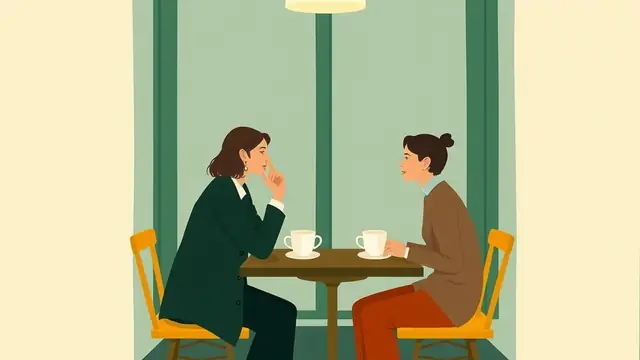
Alex and Morgan share an apartment. Morgan often has friends over late on weeknights, and Alex has an early job.
Alex's opening: "Do you have a few minutes tonight to talk about the apartment?"
Alex's NVC statement: "The last three weeknights, people were here past midnight. I've been feeling exhausted and a bit resentful, because I need sleep to function at work. Would you be open to wrapping up by eleven on weeknights?"
Morgan: "I didn't realize it was that loud. Weekends are when most people can come, though."
Alex reflects: "So weekends are when your friends are free, and weeknights are harder for them to give up?"
Morgan: "Kind of. Maybe we could do eleven on Monday through Thursday and leave Friday open."
They didn't get there because Alex had perfect words. They got there because Alex was specific, didn't blame, and listened.
When it's hard to speak up at all
Some people know exactly what to say but freeze in the moment. If that's you, it can help to build confidence in smaller conversations first. Our guide on building self-confidence explains how small, repeated actions build the kind of evidence that makes speaking up feel less risky.
Sometimes, the hardest thing to communicate is a plain refusal. Our guide on how to say no offers short scripts for those moments, so you don't have to build an NVC statement for every request.
Common pitfalls
- Kitchen-sinking: bringing up every past grievance at once. Stick to one topic.
- Mind reading: assuming you know why they did it. Ask instead.
- Winning: treating the talk as a debate. The goal is understanding, not points.
- Texting the big stuff: tone gets lost. Save important talks for voice or face to face when you can.
A note on safety and support
These tools assume a relationship where both people can disagree safely. If you're afraid of how someone will react to a hard conversation, communication techniques aren't a safety plan. In the US, the National Domestic Violence Hotline is available at 1-800-799-7233 or by texting START to 88788.
If you're thinking about paying for a communication course or coaching, our guide on whether self-help programs are worth it can help you decide.
Try this today
Think of one small, recurring irritation. Write it out using the four NVC parts: observation, feeling, need and request. Read it out loud once, then share it with the other person this week, at a calm moment.
Want a structured program to keep you on track?
Reading gives you the ideas. Some people stick with change better when they follow a guided course day by day. This button opens a self-improvement program from one of our advertising partners.
See the partner program →We may be paid when you click. The program shown can change. Read its terms before you buy anything. How this works
Frequently asked questions
What are the most important communication skills?
Listening well, describing what happened without blame, naming your feelings and needs, and making a clear request cover most situations. Timing and tone matter too, since the same words land differently when someone is rushed or upset.
What is an example of an "I" statement?
"I feel stressed when the dishes pile up overnight, because I start the morning behind. Could we wash them before bed?" It describes your experience and makes a request instead of labeling the other person.
How do I start a difficult conversation?
Ask for a good time first, open with your goal for the relationship, and describe one specific situation. For example: "Can we talk tonight? I want us to feel like a team on chores, and I'd like to talk about last weekend."